

Every week another ad made entirely with artificial intelligence comes out, and every week someone asks whether shooting is still needed. The short answer: it depends on what you want to say. This is what we have learned making the fiction part of a film with AI.
What an AI-made ad is
It is a piece in which the images, and sometimes the voice and music, are generated by AI models from text and reference images, with no camera. What AI does not generate is the ad itself: the idea, the script, which shot follows which, the pace of the edit, the colour and the sound are decided by people, just as on a shoot.
That is why an AI ad is not made by “asking a machine”. Hundreds of shots are generated, almost all are discarded, the good ones are fixed and then edited together. The work moves somewhere else, but it does not go away.
What AI does well today
- Past eras and places that no longer exist. A street in 1900, a building half built, an interior from another century, with no sets or costumes.
- Impossible worlds. Things that would be very expensive to shoot, or simply impossible.
- Many versions of the same campaign. Other settings, other audiences, other formats, without shooting again.
- Seeing the ad before making it. An animated storyboard or a teaser to win over whoever has to approve it.
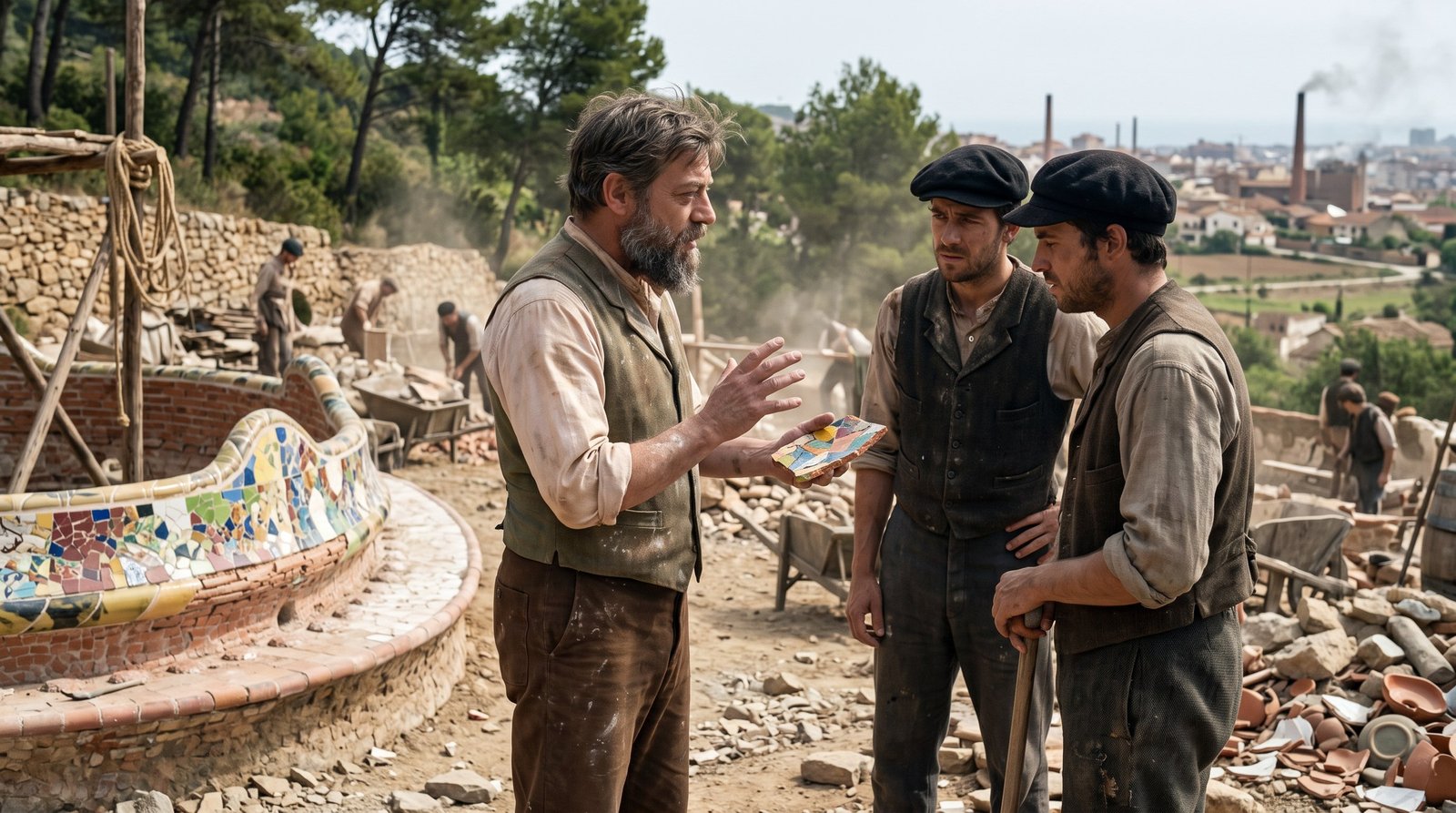
We have tested it on Luz y Misterio: La fe de Gaudí, our documentary for 2027: all of its fiction, from Gaudí’s childhood to the building of Park Güell, is made with AI. The interviews and today’s locations, on the other hand, were shot on camera.
What it still does not do well
- Your product exactly as it is. Logos, labels and any text inside the image tend to get distorted. If the packaging has to look exact, it has to be shot or composited separately.
- The same person across many shots. Keeping a face, clothes and lighting consistent from shot to shot is possible, but it takes work and many discarded takes.
- Fine details. Hands, small gestures and long lip-synced dialogue still give AI away unless they are handled with great care.
- The truth. A testimonial, your team, your premises or a real customer cannot be generated: if what you are selling is that it is real, it has to be shot.
Shot, made with AI or both: what it costs
| Ad | Up to 60 s (+ VAT) | 1-2 min (+ VAT) | Usual lead time |
|---|---|---|---|
| Shot on camera | €4,500-6,300 | €5,800-8,200 | 5-8 weeks |
| Shot, with parts in AI | €5,600-7,900 | €7,300-10,300 | 5-8 weeks |
| Made with AI, no shoot | €3,000-4,300 | €3,900-5,500 | 3-5 weeks |
Guide prices from our estimate calculator, for an ad with concept, script, editing, colour, sound and 16:9, 9:16 and 1:1 versions. The mixed option costs more because it adds a shoot to the generation work.
With no shoot there is no crew, equipment or travel, which makes the piece cheaper and faster. What you do not save on is the script or post-production, which with AI usually takes more hours than with a camera.
The rules we follow
- People in charge. Script, direction and editing are done by people. AI is one more tool in the team.
- No face or voice without permission. If a real person has to be recreated with AI, we first ask for their written permission.
- We always disclose it. We say what has been generated with AI. Since 2 August 2026, the EU AI Act (Article 50) requires disclosure when an image, audio or video is a deepfake made with AI, according to the law firm Houthoff (accessed 6 November 2026). We help you comply in your campaign.
How to tell whether your ad can be made with AI
Ask yourself three questions:
- Does your exact product have to appear, with a readable label? Then at least that part should be shot on camera.
- Is the message that something is real: your people, your factory, your customers? On camera.
- Do you need another era, an impossible place or many versions? That is where AI saves you money and time.
If you are not sure, that is normal: often the best answer is to combine both. Work out the price of your ad by choosing shot on camera, made with AI or “I don’t know yet”, or see when we use AI and when we don’t and what we do for brands.